Have you ever wondered how AAC boards can make Halloween more inclusive and enjoyable for everyone?
For many children and adults who use augmentative and alternative communication (AAC), holidays like Halloween can bring both excitement and communication challenges.
From saying “trick-or-treat” at the door to joining in games, parties, and conversations, communication is at the heart of the celebration.
AAC boards can be one helpful option for making Halloween communication more accessible, especially when they are used alongside the person’s regular communication system.
With themed vocabulary, visual prompts, and easy-to-use designs, these tools can give AAC users another way to express themselves, share in the fun, and participate in traditions on their own terms.
During a holiday filled with costumes, candy, and community, AAC boards open the door to connection and belonging.
So grab your pumpkin pail, slip on your costume, and let’s unlock the magic of Halloween together! 🎃

What Is AAC and Why Does It Matter on Halloween?
Halloween is full of costumes, candy, and excitement, but for autistic children who use AAC, the night can also bring sensory and communication challenges.
Augmentative and Alternative Communication (AAC) includes many ways of communicating beyond or alongside speech, such as gestures, signs, pictures, communication boards, writing, apps, and speech-generating devices. AAC can support communication without requiring a child to rely on spoken words.
Imagine your child holding up a Halloween-themed communication board at a doorstep.
They might point to “Trick or Treat,” “Thank you,” “Happy Halloween,” or something completely different they want to communicate. The important part is having a reliable way to participate without spoken words being required.
A Halloween communication board can include useful words and phrases for the night, but it should still fit the individual AAC user’s communication needs. AAC is not one-size-fits-all, and a person’s regular system, symbols, vocabulary, gestures, speech, or other communication methods should remain available to them.
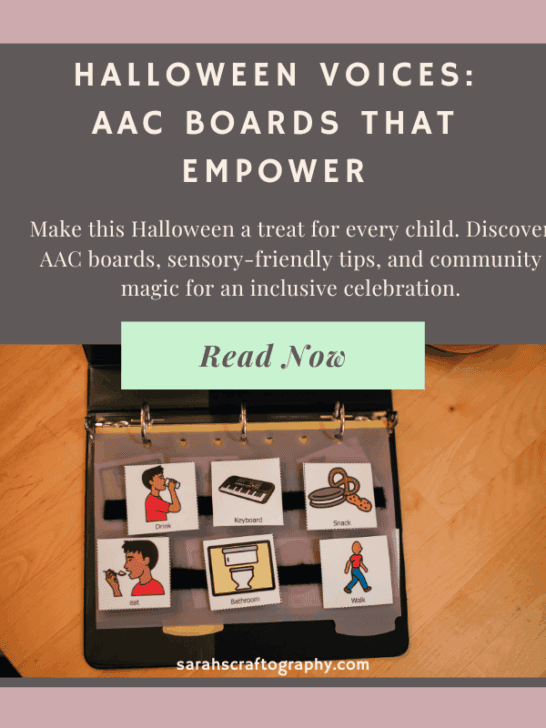
If you make a low-tech Halloween board, laminating or protecting it from the weather can make it easier to carry on a night of treats, costumes, and maybe even a little rain.
AAC should stay available throughout the night rather than being treated as something a child earns or only receives when spoken communication is difficult.
Low-tech boards can also be easy to keep on hand.
Clip them to a costume, attach them to a lanyard, slip them onto a wristband, or tuck them into a treat bag—wherever your child can comfortably and easily access them.
Parents and caregivers can model AAC by pointing to symbols while they communicate, giving the child a chance to see the board used naturally. It also helps to allow plenty of wait time rather than requiring a spoken response or making the child prove they can use a symbol before moving on.
Introducing a Halloween board before the big night can make it more familiar. Families might play pretend at home, practice knocking on a door, or simply explore the Halloween vocabulary together without turning the practice into a test.
Some kids will love colorful clip art, while others may prefer simpler symbols, photographs, written words, or their regular AAC system. Keeping the child’s familiar vocabulary and symbol layout available can make communication easier, especially on a busy night.
With AAC, Halloween becomes less about barriers and more about belonging.
It’s about making sure every little ghost, witch, or superhero gets to share in the joy of the season.
Because when communication is accessible, the magic of Halloween is for everyone. 🕷️🍬
For neighbors and other communication partners, a few simple habits can make a big difference: speak directly to the AAC user, keep their communication system within reach, reduce distractions when possible, and give them enough time to respond. Communication does not need to be spoken to be meaningful.
A Quick Halloween AAC Checklist
- Keep the person’s regular AAC system available throughout the celebration.
- Add useful Halloween vocabulary without removing everyday words, choices, boundaries, and requests.
- Make sure the AAC user can physically reach and access the board or device.
- Model AAC naturally instead of requiring the person to copy or perform a phrase.
- Allow extra time for processing and responding.
- Respect “no,” “stop,” “break,” and other forms of refusal or self-advocacy.
- Have a low-tech backup available when practical, especially for outdoor activities.

Giving Every Ghoul a Voice: Communication Board Design
Designing Halloween communication boards is more than placing words and pictures on a page. It is about creating a useful tool that helps an AAC user communicate what matters to them during the fun.
The foundation of these boards lies in the symbols and phrases.
Halloween-specific phrases such as “Trick or Treat,” “Thank You,” “Happy Halloween,” “More Candy,” and “Scary Fun” can be useful additions. However, they should not replace everyday words a person may need, such as “yes,” “no,” “stop,” “help,” “different,” “I want,” or “I don’t want.”
Halloween pictures can make a board festive, but the symbols and layout should remain as familiar as possible to the AAC user. Familiarity can matter more than making the communication system match the costume or decorations.
Customization is key.
Some AAC users may prefer bright, colorful images, while others communicate more easily with familiar symbols, photographs, written words, or another established system.
Understanding how your child learns and communicates makes the board more meaningful and keeps them engaged.
Letting them pick their favorite colors, choose symbols, or add a sticker of a pumpkin or black cat helps foster ownership and excitement.
For some children, sensory features may make a board more engaging, while for others extra textures, visual effects, or scents could be distracting or uncomfortable.
The best design is the one that matches the individual AAC user’s visual, sensory, motor, and communication needs.
Practical details matter too.
Laminating or waterproofing keeps boards safe from sticky candy fingers or rainy trick-or-treat nights.
Smaller boards can clip onto costumes, slip onto a lanyard or wristband, or tuck into a treat bag so they’re always within reach.
Boards with Velcro or magnetic pieces add flexibility, letting kids swap out symbols to match their mood or the activity at hand.
Most importantly, don’t overlook the fun.
If decorations are added, make sure they do not make symbols harder to see, change a familiar layout, or interfere with the person’s ability to access the board. Communication comes first; the Halloween decorations are optional.
With thoughtful design, these AAC boards give every little ghoul, witch, or superhero the chance to join in the excitement, because every child deserves to feel the magic of Halloween. 🎃
So, how will you design your child’s board to make this spooky season unforgettable?

Ghosts, Goblins, and Great Conversations
For children with communication needs, Halloween night can feel like a whirlwind of costumes, crowds, and candy.
AAC strategies can make communication more accessible during a busy Halloween night, while flexibility, patience, and attention to the individual’s needs can help make the experience more comfortable.
Preparation can help, but the goal is not to make a child perform certain Halloween phrases. Their AAC should give them access to a range of things they may actually want to say.
Start by introducing the board well before the big night.
Practice runs at home—knocking on doors, pretending to hand out candy, or role-playing different scenarios—can make the routine more familiar. Keep it low-pressure: a child does not need to say or select “Trick or Treat,” “Thank You,” or “Happy Halloween” to deserve patience, inclusion, or a treat.
This kind of rehearsal can make the routine and vocabulary more familiar before Halloween night, especially for a child who likes knowing what to expect.
Parents and caregivers can strengthen the experience by modeling.
As you walk from house to house, point to symbols on the board to show how to use them in real conversations.
Try phrases like “I like your costume!” or “Let’s go to the next house!” so your child sees the board in action.
Then give them time to respond in the way that works for them. Participation does not have to look like spoken conversation to be meaningful.
Flexibility is key.
Trick-or-treating can be unpredictable, so keep extra cards or a larger backup board handy.
Make sure AAC boards are easy to reach, clipped to a treat bag, attached to a lanyard, or slipped onto a wristband, so they’re always ready when needed.
Keep the communication system where the AAC user can reach and use it. Neighbors can help by speaking directly to the person, giving them time to respond, and accepting whatever communication method they use.
In the end, AAC transforms trick-or-treating from a simple candy quest into something much bigger: an opportunity for children to express themselves, connect with others, and shine in their own way.
With patience, creativity, and a touch of Halloween spirit, those knocks on the door become more than just about sweets; they can become moments of connection. 🎃👻
Helpful Reminders for Neighbors
- Speak directly to the child or adult who uses AAC.
- Do not require “trick-or-treat” or “thank you” before offering a treat.
- Give the person time to communicate without rushing or finishing the message for them.
- Accept communication through AAC, speech, gestures, signs, writing, facial expressions, or another method.
- Respect “no,” “stop,” requests for a break, and other boundaries.

Making Halloween Comfortable for Every Child
Halloween is filled with sights, sounds, and surprises, glowing decorations, spooky music, crowded sidewalks, and costumes of every kind.
For autistic children, this sensory-rich environment can be both exciting and overwhelming.
A night that many kids look forward to can quickly turn stressful if the environment becomes “too much.”
But with thoughtful planning, families can turn potential triggers into opportunities for comfort and joy.
Every child experiences the holiday differently.
Some may find flashing lights or eerie sound effects unsettling, while others may dislike the feel of masks, itchy fabric, or face paint.
Recognizing these triggers ahead of time helps you create a plan that feels safe for your child.
Think about asking: What parts of Halloween light up your child’s eyes, and what parts make them withdraw?
AAC boards can play a role here too, not just for trick-or-treating, but for sensory needs.
A board that includes messages such as “Too loud,” “Break please,” “Take it off,” “I need quiet,” “Stop,” and “I want to go home” can help children communicate sensory needs, boundaries, and choices in the moment.
Portable boards or laminated cards clipped to a costume or treat bag make those requests quick and easy.
Preparation is key.
Social stories, visual schedules, or even a short video walk-through of your planned route can ease uncertainty. If your child benefits from knowing what to expect, my guide to preparing an autistic child for Halloween has more ideas for making the holiday predictable without taking away the fun.
Practice wearing costumes well before the big night — maybe start with just the cape or hat and build up slowly.
If your child prefers, consider comfy alternatives: pajamas decorated with Halloween themes, a favorite hoodie paired with wings, or even just carrying a small prop.
The goal isn’t the “perfect costume” but a comfortable one.
Don’t forget to plan for breaks. Create a “safe zone” at home or in the car, a cozy space with headphones, a favorite blanket, or fidget toys.
Let your child know they can use their AAC board to request time there whenever they need it.
Some families even bring a small flashlight or glow stick as a “signal” for when it’s time to pause and regroup.
Most importantly, make the evening flexible. Maybe your child prefers visiting just a few trusted neighbors, attending a sensory-friendly community event, or celebrating at home with themed crafts and treats. If hands-on traditions are more your child’s speed, you can also try these autism-friendly pumpkin carving ideas.
All of these are valid ways to enjoy Halloween.
So as you plan your night, think about this: How can you shape Halloween around your child’s comfort, rather than trying to fit them into the traditional mold?
When children feel safe, they’re free to enjoy the magic of the season in their own unique way. 🎃✨

Neighborhood Magic: Awareness in Action
Halloween doesn’t just happen in our homes; it comes alive on porches, sidewalks, and doorsteps.
That’s why community awareness is such a powerful part of making the night inclusive.
When neighbors understand and celebrate all the ways children communicate, they help create a kind of “neighborhood magic” where every child feels welcome.
Think about the impact a simple gesture can have.
A sign on the porch that says AAC-Friendly Home, or a neighbor who bends down, smiles, and patiently waits while a child points to “Trick or Treat” on their board, these small actions send a big message: your voice matters here.
Some families use a blue Halloween bucket as an informal way of signaling that an autistic child may communicate or participate differently. My own family does not use this approach, and no child should need a special-colored bucket or disclose a diagnosis in order to receive kindness, candy, patience, or respect.
Families can choose whatever feels right for them, whether that is an AAC board, a conversation with neighbors, a familiar trick-or-treat routine, or no special signal at all.
Imagine if your block set up a “sensory-friendly stretch” with dimmer lights and quieter music.
Or if a neighbor organized a mini practice run the night before, giving kids a chance to explore without the pressure of crowds.
These creative touches don’t just support children who use AAC, they strengthen the entire community.
This is where you come in.
Could you host a short conversation at your local school, church, or community center about AAC and inclusivity?
Could your family add a welcoming sign or prepare both candy and small non-food treats to meet different needs?
Even neighborhood kids can play a role by learning about AAC and practicing patience when a peer communicates in a different way.
Halloween is at its best when it’s about more than candy; it’s about connection.
Every neighbor has the chance to turn their porch light into a beacon of acceptance.
So as you plan your decorations, costumes, and candy stash, ask yourself: What can I do this year to make my neighborhood’s magic shine brighter for every child who knocks? 🎃✨

Inclusive Fun Beyond the Doorstep
Not every family spends Halloween walking from house to house.
Some prefer the safety and structure of a trunk-or-treat event, while others gather for a school or community party. The good news?
AAC and sensory-friendly strategies can shine just as brightly in these settings.
At trunk-or-treats, families often move from car to car in a parking lot.
This can actually make AAC use easier because boards can stay clipped to a treat bag or lanyard without getting lost in the shuffle.
Make sure useful phrases such as “Happy Halloween!” or “That’s cool!” are available if your child wants to use them while admiring decorated trunks.
Organizers can help, too, by offering a quiet trunk or low-sensory zone where children can pause and regroup.
Even a trunk that hands out small non-food treats (like glow sticks or stickers) can make kids with allergies or sensory sensitivities feel included.
Halloween parties, whether at school, church, or a friend’s house, are another opportunity for inclusion.
AAC boards can be customized with social phrases like “I want to dance,” “Let’s play a game,” or “Can I have a snack?” to help children join group activities.
For hosts, a few simple adjustments—dimmer lighting, a corner with soft seating, quieter music, or explaining AAC to volunteers—can go a long way toward making autistic children and other AAC users feel welcome.
For readers who might be planning one of these events, here’s something to keep in mind: not every child communicates in the same way.
Building flexibility into the environment—from how kids ask for candy to how they step away when it’s too much—creates a celebration with more room for every ghost and goblin to participate in a way that works for them.
So whether you’re attending or hosting, the question becomes: How can you help turn your event into a place where every child not only joins in, but truly belongs? 🎃👻

Halloween Communication Is About Connection
Halloween should be a time of joy, laughter, and memory making, not stress or exclusion.
With AAC boards, sensory-friendly strategies, and a little neighborhood awareness, every ghost, goblin, princess, and superhero can join in the fun.
Whether your family goes trick-or-treating, enjoys a trunk-or-treat, or celebrates at a party, the heart of the night is connection.
Now it is your turn.
I would love to hear from you!
Do you already use AAC or sensory supports during Halloween?
What tips, tricks, or stories can you share to inspire other families?
Drop your thoughts in the comments and let us keep this conversation going. 👇
If you found this post helpful, share it with your community on social media.
Together, we can spread awareness, spark ideas, and create more inclusive celebrations.
A voice does not have to be spoken to matter. Speech, AAC, gestures, signs, facial expressions, writing, and other forms of communication all deserve to be recognized. When every person’s communication is respected, Halloween truly becomes a treat for all. 🕸️🍬👻
If you loved this post and want to make your Halloween a little more magical, don’t forget to subscribe to my email list! When you sign up, you’ll get free printable AAC cards to help your child express themselves during trick-or-treating, parties, and more. Plus, you’ll be the first to know when new inclusive resources and family-friendly ideas are added to the blog.
Leave a Reply