

Have you been looking for sensory-friendly Halloween ideas kids will love without forcing them through a night that feels too loud, itchy, crowded, or overwhelming?
Halloween can be exciting, but it can also ask a lot from a child all at once.
Costumes feel different.
Doorbells ring.
Decorations move without warning.
People wear masks. Streets get crowded, routines change, and everyone seems to expect children to know exactly what to do.
In our family, I have learned that a successful Halloween is not measured by how many houses we visit or how full the candy bucket gets.
It is measured by whether my kids felt safe enough to enjoy themselves.
That may mean a soft costume instead of an elaborate one, an early trick-or-treat walk, headphones in the bag, a quiet break in the van, or skipping an activity altogether.
Sensory-friendly does not mean taking the fun away.
It means making room for a child to enjoy the fun in a way that works for them.

When Halloween Feels Like Too Much
Halloween has never been as simple as buying costumes and heading out the door with my kids.
For Trinity, costumes were not always exciting.
Some scared her, and tight or uncomfortable textures could make her feel trapped.
Alivia's needs are different.
She does not like masks or heavy makeup, but she has loved blow-up costumes and simple combinations that let her participate without feeling weighed down.
We have done things like a black sweat outfit with butterfly wings, glitter spray in her hair, or a simple pair of cat, dog, or fox ears with a small tail.
Those little touches still feel festive without turning the costume into something she has to endure.
Sensory needs can show up in other parts of Halloween too.
Flashing lights, motion-activated decorations, fog machines, crowded sidewalks, unfamiliar smells, sudden screams, and people bumping into one another can turn a fun evening into sensory overload very quickly.
Sensory accommodations such as comfortable clothing, headphones, visual supports, quieter spaces, and avoiding crowds can make community activities more accessible.
Autism Speaks also recommends adapting the environment to the person's individual sensory needs.
If your child reaches their limit, leaving is not a ruined Halloween.
Sometimes leaving at the right time is exactly what protects the good memories you already made.
Start With a Halloween Plan Your Child Can Understand
Predictability can make a big difference.
Before Halloween, talk through what is going to happen in a way your child understands.
That might be spoken conversation, pictures, a visual schedule, a calendar, a short practice walk, or a personalized teaching story.
You can practice putting on the costume before Halloween instead of discovering an itchy seam five minutes before leaving.
Walk through knocking on a familiar door.
Show your child the trick-or-treat bucket.
Talk about masks and decorations they may see.
Most importantly, tell them what the exit plan looks like. Knowing, "We can go back to the car when you need a break," can be just as important as knowing where you are going.
Autism Speaks offers an All About Halloween personalized teaching story that families can adapt with their own pictures and information.
Comfy Halloween Costumes Come First
The costume may be the star of Halloween for some kids, but comfort gets the starring role in our house.
Trinity taught me this early.
Soft cotton and fuzzy outfits worked much better than tight, scratchy costumes.
One year she surprised me by wanting to be a zombie.
Instead of using a mask or covering her face in heavy makeup, I tore up an old dress, rubbed it in the dirt, and used a little eyeliner, lipstick "blood," and dark shading.
She got the spooky zombie look she wanted without having to tolerate a costume that made her miserable.
Alivia has her own preferences.
Sometimes she likes a blow-up costume.
Other times something as simple as sweats, wings, ears, or a little glitter works better.
Try the costume at home before the big night. Remove tags.
Add soft clothes underneath when that helps.
Skip masks or face paint if they bother your child.
Bring a backup option that fits in your bag.
A pair of ears or a favorite Halloween shirt can save the night when the original costume suddenly becomes too much.
And remember: a child does not have to wear a costume at all to participate in Halloween.

Sensory-Friendly Halloween Fun at Home
Some of our favorite Halloween memories did not happen while trick-or-treating.
We have made sensory bins with rice dyed black, orange, green, and purple, then added tiny pumpkins and Halloween trinkets.
Slime, kinetic sand, or a simple treasure hunt can be fun too, as long as the texture is one your child actually enjoys.
Pumpkin guts are definitely not a favorite in my house.
Instead of insisting on carving, we paint and decorate pumpkins.
Stickers, washable paint, markers, craft supplies, or push-in decorations can give kids the pumpkin experience without requiring them to scoop out a texture they cannot stand.
We have also bobbed for apples, played sensory guessing games, gone on flashlight scavenger hunts, and once turned our garage into our own Halloween party with softer lights, music, a little dance floor, and door prizes.
The kids still remember it.
Halloween does not have to look traditional to become a tradition.
Trick-or-Treating Without the Pressure
If we go trick-or-treating, I try to make the experience fit my kids instead of expecting my kids to fit the experience.
Starting earlier can mean smaller crowds and less noise.
Familiar neighborhoods, friendly cul-de-sacs, smaller trunk-or-treats, church events, and library programs can also feel more manageable than a huge community event.
I bring the things we may need: headphones, a sensory item, real snacks, and a backup costume piece.
I also watch for the point where excited energy starts turning into exhaustion.
Sometimes I will say, "Two more houses, and then we're heading to the van."
A clear ending can make the transition easier.
Afterward, we may drive around and look at decorations from the safety of the vehicle.
That gives everyone time to come down from the excitement before heading home.
Your Child Does Not Have to Say "Trick or Treat"
This is one Halloween expectation I would love to see more adults understand.
Not every child can say "trick or treat." Some communicate with AAC.
Some use gestures, signs, pictures, or a communication card.
Others may be able to speak but freeze when an unfamiliar adult opens the door.
A child may also be using every bit of their energy simply to stand on that porch.
They still deserve kindness and a piece of candy.
Eye contact should not be the price of participation either.
Neither should saying "thank you" on command, tolerating a scary decoration, or explaining a disability to a stranger.
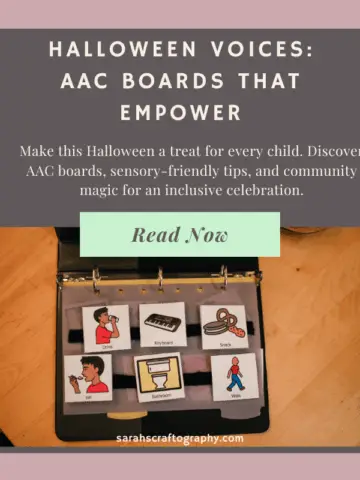
If your child uses AAC or would benefit from a visual communication option, I put together a separate resource about Halloween AAC boards and giving kids a way to communicate during Halloween.
For the adults answering the door, a little patience goes a long way.
Give the child time. Accept the communication they offer.
Let Halloween be about welcoming the kid standing in front of you rather than testing whether they perform the tradition correctly.
Create a Safe Signal and a Quiet Escape
At home, my kids know they can retreat to their rooms when they need a break.
When we are out, having a simple signal can help them tell me they are reaching their limit before everything becomes too much.
Alivia uses the phrase "thunder popcorn" when she feels like she is losing control.
It sounds silly to someone who does not know what it means, but for us it is powerful communication.
I know what she is telling me, and we can respond.
Your family's signal might be a phrase, a hand sign, a picture on an AAC device, pointing to a break card, or simply handing you a particular object.
Whatever it is, honor it.
A signal only feels safe when a child learns that the adults around them will listen to it.
A Few Halloween Safety Adjustments
Planning for sensory needs and planning for physical safety can work together.
I like to know our route before we leave and avoid houses with decorations I already know will be too much.
Glow wands work well for my kids because they enjoy holding them more than wearing glowing necklaces or bracelets.
Other children may prefer reflective patches or light-up shoes.
It can also help to take a current photo of your child in their costume before leaving, make sure they have identification or contact information appropriate for their needs, and choose a meeting spot if you are attending a larger event.
Autism Speaks similarly recommends planning for visibility, identification, communication, and the possibility of wandering during Halloween activities.

There Is No One Right Way to Do Halloween
Your child does not have to wear a costume.
They do not have to trick-or-treat.
They do not have to stay until an event ends, pose for every picture, touch pumpkin guts, walk through a haunted house, speak to strangers, or enjoy something simply because other children do.
One child may love the lights and hate the costume.
Another may happily wear an elaborate costume but need headphones outside.
Someone else may want to hand out candy from home instead of walking door to door.
All of those Halloweens count.
When I stopped measuring the night against what Halloween was "supposed" to look like, it became much easier to notice what my kids actually enjoyed.
Making Halloween About Joy, Not Perfection
As a mom, I want my children to know they do not have to perform for other people to belong.
I believe God created each of us with worth that does not depend on how well we fit somebody else's expectations.
That changes the way I look at celebrations too.
Sometimes loving our children well means changing the plan, leaving early, choosing the quieter event, or celebrating at home.
If you are also curious about where some of the holiday's familiar traditions came from, you can read my newly updated post about the legends of Halloween.
This Halloween, pay attention to the moments when your child relaxes, laughs, explores, communicates, or simply feels safe enough to be themselves.
Those are the memories worth keeping.
What sensory-friendly Halloween tradition works best for your family?
Share it in the comments.
Your idea may be exactly what another parent needs this year.



Leave a Reply